
Mathematics, Logic, and Number Theory
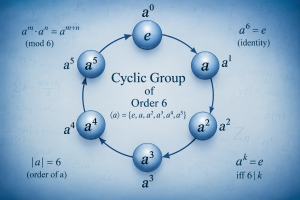
Group Theory: Order of an Element
An introduction to a fundamental idea in group theory: the order of an element.
Using modular groups and worked examples, this article shows how successive
exponentiation leads back to the identity element and provides a practical
method for calculating element orders.
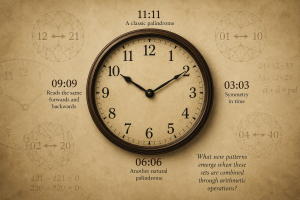
Palindromes on the 12-Hour Clock
A mathematical exploration of the palindromic patterns hidden in an ordinary 12-hour clock. Beginning with naturally occurring symmetric times, the
investigation develops sets of palindromes and asks what new patterns emerge when those sets are repeatedly combined through arithmetic operations.
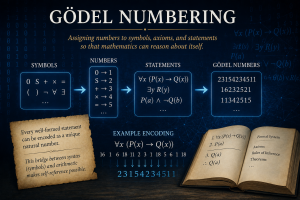
Gödel Numbering
An introduction to Gödel’s remarkable method of translating the language of formal mathematics into numbers. By assigning numerical representations to
symbols, axioms, and statements, Gödel made it possible for a formal system to reason mathematically about its own structure.
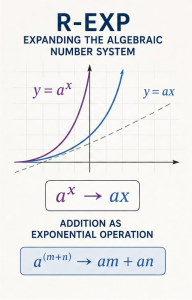
The System of R-Exp: Expanding the Algebraic Number System
An exploration of an alternative extension of algebra in which addition is
introduced as an exponential operation. The article develops the proposed
R-Exp system and considers how changing the structure of exponentiation may
produce new mathematical operations and relationships.
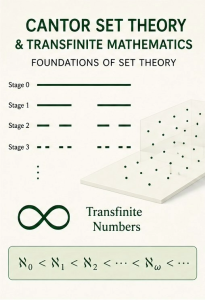
Cantor Set Theory & Transfinite Mathematics — Foundations of Set Theory
An examination of Cantor’s foundational ideas in set theory and the mathematics
of the infinite. The article explores cardinality, infinite sets, and transfinite
numbers, showing how Cantor’s work created a rigorous mathematical framework
for comparing different orders of infinity.
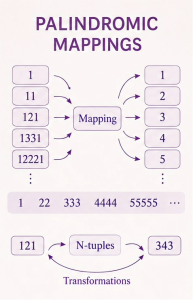
Palindromic Mappings
An investigation of mathematical structures generated from palindromes and
mappings between palindromic sequences and natural numbers. Beginning with
letter patterns, the article develops numerical transformations and palindromic
N-tuples, revealing unexpected relationships between cardinal and ordinal
palindrome constructions.
Personal Essays & Philosophy
The Existential Concept: Existentialism 1
An exploration of existentialism through the question of whether perfection has any intrinsic meaning. Using mathematical “perfect numbers” as a revealing example, the essay examines how human beings assign concepts and standards to reality—and asks whether those labels describe something inherent in the world or something we ourselves create.

The Meaning Of Freedom and Death: Existentialism 2
An existential examination of freedom, choice, and mortality. Confronting death and a reality without predetermined purpose, the essay argues that human freedom lies in choosing how to live within those conditions—and in the conscious acts of thought and creation through which we give form and meaning to existence.
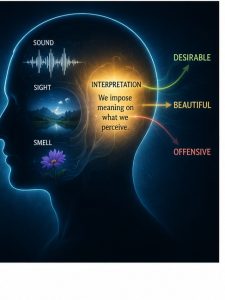
Meaning and Interpretation: Existentialism 3
An exploration of how human beings create meaning from an external world that does not inherently provide it. Drawing on everyday experiences of sound, sight, and smell, the essay distinguishes sensory perception from the interpretations we impose upon it—transforming what we perceive into judgments such as desirable or unpleasant, beautiful or offensive, and ultimately meaningful.

Iconoclasm: Existentialism 4
An examination of iconoclasm as existentialism expressed through a rejection of culturally assigned meaning. The essay questions rituals,
celebrations, institutions, traditions, and social conventions, while exploring how satire and cultural criticism challenge beliefs that society
often treats as inherently significant.
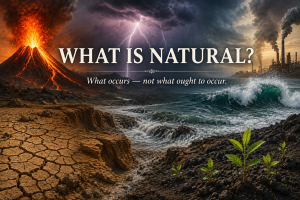
What Is Naturalism?: Existentialism 5
An exploration of what it means to call something natural. Rejecting the idea that nature represents an ideal condition, the essay argues that everything occurring within reality—including human action—is natural,
while moral judgments such as good, bad, desirable, or undesirable remain interpretations we impose upon events.
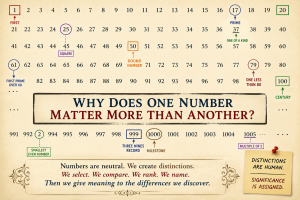
Numeration and Uniqueness: Existentialism 6
A philosophical examination of humanity’s fascination with counting, ranking, records, and uniqueness. Using mathematical and everyday examples, the essay argues that distinctions such as first, tallest, shortest, or one-of-a-kind acquire significance only because human beings
define attributes and then assign meaning to the differences they discover.

English Words That Are Becoming Archaic and Words That Are Not
An examination of changing English usage through words and contractions
that are disappearing, surviving, or changing their function. The essay
considers why familiar forms become uncommon while closely related
expressions remain part of everyday speech and writing.

A Look At Compound English Words
An exploration of the remarkable ability of English to combine words
into new expressions. Beginning with its Germanic linguistic inheritance,
the essay investigates compound and reversed compound words and asks how
extensively new meaningful constructions can be generated from the
existing English lexicon.
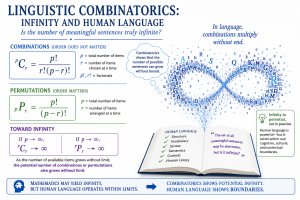
Linguistic Combinatorics: Infinity and Human Language
A mathematical and linguistic investigation of whether human language
can truly generate an infinite number of meaningful sentences. Using
combinatorial reasoning, the essay questions linguistic infinity and
distinguishes an enormous potential number of expressions from an
actually infinite human language.

An Adulterous Affair: What Happened Between Him and Her
A fictionalized narrative of a real life experience I had with a Filipina woman 30 years ago. It examines an adulterous relationship through
anticipation, memory, secrecy, and desire. Written in a diaristic style it catalogs the perspectives of the two lovers, and involves the emotional complications
surrounding an illicit affair.

Are Our Devices Becoming Sentient?
An examination of increasingly autonomous communication among computers,
phones, and neural-network systems. The essay considers whether
sophisticated machine-to-machine interaction represents genuine sentience
or merely creates the appearance of independent intelligence.

Are We Really Finite?
An exploration of the boundary between finitude and infinity, asking
whether finite individuals and objects can participate in processes that
are effectively continuous or unbounded. The discussion moves through
production, networks, reproduction, mathematics, and theoretical physics.

Book Review: The Black Cloud
My review of a science fiction story that is more real than fiction. It gives a chilling account of an alien being which is like none other in the sci-fi genre. Read my analysis below.

Does Perfection Exist?
Is perfection a reality or just an abstracted conception, human beings never achieve? This is core question I try to address in this article. This survey looks at various disciplines to find a coherent answer.

Barrow Tipler Argument Against Extraterrestrial Life
The theoretical physicists Frank Tipler and John Barrow wrote a gigantic tome in the late 1990s seeking to explain why no extraterrestrial life has been detected in our galaxy. In this review, I attempt to show how their conclusion is too broadly applied. It relies on the famous Drake Equation to propose a negative thesis. I go through an example of this equation in action.
Film & Literature

Avatar: James Cameron Apologizes
In 2010 James Cameron made his first of what is now 3 science fiction dramas about life on an alien planet. I believed then, and still do now, it was sly attempt to pay penance for the shameful near genocide visited upon native peoples of this hemisphere. I also wanted to experience 3D cinema back then. It was no accomplishment in filmmaking to me at that time. See why in the article below.
Read Article →

Before The Law: A Review
This allegorical tale by Franz Kafka has elements of existentialist philosophy. If we interpret our minds as being the gatekeeper to a forbidden region of being, we do eventually approach a door to a law. The symbolism is profound, I explain why in the article below.
Read Article →

Franz Kafka’s In the Penal Colony
In another of Kafka’s macabre works, an Explorer comes to a penal institution, and witnesses a Commandant’s reversal of fortune. Of course, Kafka is making a socio-political commentary with this piece. See what it means below.
Read Article →
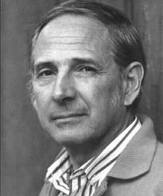
AI Consciousness Argument of John Searle
Twenty year ago there was a philosophic discussion on whether the nascent field of AI research would create a self-aware intelligence in a virtual machine. John Searle, a famous philosopher argued this was impossible. In this article I show why his argument is not to be ignored in general but fails on many points. It is still relevant today in reference to real-world AI applications. There is no self-aware AI as of 2026.

Film Review: Lola Rennt (Run Lola Run)
This was German director Tom Tykwer’s outbreak film in the late 90s, that amazed me with its unusual filmmaking technique. Franka Potente is the German actress that has a short period of time to raise 100K Deutsch Marks to save her criminal boyfriend, Manni who has lost that sum which he was to deliver to a dangerous thug companion. How she goes about accomplishing this task is what Run Lola Run shows us.

Football Games and Commercials
Imagine this football fan, when you watch the 3 hours + of any American football, you are actually only watching about 12 minutes of actual game being played. You say what? What the fuck, you’re kidding. I am not. Read the detailed analysis I performed of one such game in the article below.

Cria: A film by Carlos Saura
A young girl is regularly visited by the apparition of her dead mother. Her mother died from cancer years before the start of the film. Ana, the young girl, interacts with several deceased people. However, Saura creates the film sequences with ambiguity. You are not sure if Ana is really hallucinating. Her ghostly visitors don’t engender fear in her, instead she creates an enlightened image of her past and the adultery of her father.
Read Article →
The Nature Of Dreams Part 1
A description of some typical dreams and analysis of their possible meanings.
Dreams Part 2
In the second analysis of dreams, a consideration of lucid dreams is reviewed. What about a new kind of dreaming, which I have dubbed conceptual dreaming. This is a dream which the one plans before going to sleep.
Brazilian Music & Portuguese Translations

Fixação
My translation of the Brazilian singer Paula Toller singing Fixação (Fixation) in the group Kid Bee (Kid Abelha). She describes a woman that is hopelessly infatuated with a man.
Read Article →
Construção / Construction
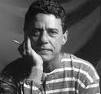
Chico Buarque sings Construção, a song with existentialist undertones. Recorded in 1971, during the military dictatorship, it was a veiled commentary on the authoritative control of the military and how it dehumanized common workers. A man’s life is falling apart with each verse as he goes to and from a large construction site, until it finally kills him. Buarque cleverly avoided censorship by making the song about a man being destroyed by a construction project. It was about the Brazilian people really, being oppressed by a CIA installed government. Read my translation and listen to the song below.
Read Article →

O Rei Chegou viva O Rei
A translation of what I can only call an occult song by Jorge Ben Jor, my favorite Brazilian artist for many reasons. The song in brief sings the praises of a mythical King that has come to give the populace as he says in the tune Justice, Sympathy and Knowledge. There are no political hidden messages in this tune. It is really just an almost comic version of monarchy but you can’t help liking the voice of Jorge Ben Jor and his background group, chanting the title verse as we hear him extolling a personage that no longer exist.
Read Article →